Emergency General Contractor Near Me: What Victorville Homeowners Should Do First
When a roof tears open during a Victorville windstorm or a supply line bursts at 2 a.m., the first 60 minutes matter more than most people realize. Emergency general contractor response in Victorville starts with three moves: stop the water or intrusion, document everything with photos and timestamps, then verify any contractor’s CSLB license before signing anything. If you’d rather not run that gauntlet alone, call (855) 600-3192 and we’ll walk you through it.
Here’s what most homeowners get wrong: they call the first number that pops up, sign whatever gets put in front of them, and discover weeks later they’ve waived protections California law put in place specifically for this moment. This guide covers the damage-specific sequence you should follow before you commit to anyone.
Key Takeaways
- California’s CSLB gives you protections after disaster damage. You can invoke them, but only if you know they exist.
- Separate emergency stabilization from restoration. They are two different contracts with two different risk profiles.
- Document everything before anyone touches the property. Insurance claims live or die on the first 24 hours of evidence.
- The right general contractor coordinates faster than calling five individual trades.
- Victorville’s high-desert climate creates specific failure patterns you should understand before repairs begin.
Step One: Stop the Active Damage Before You Call Anyone
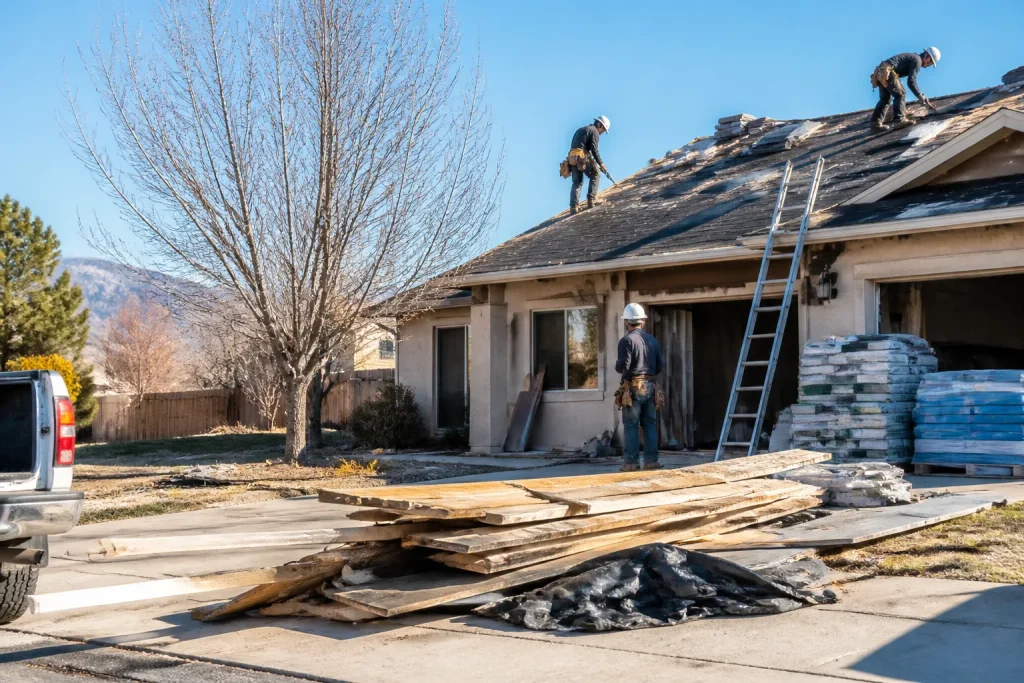
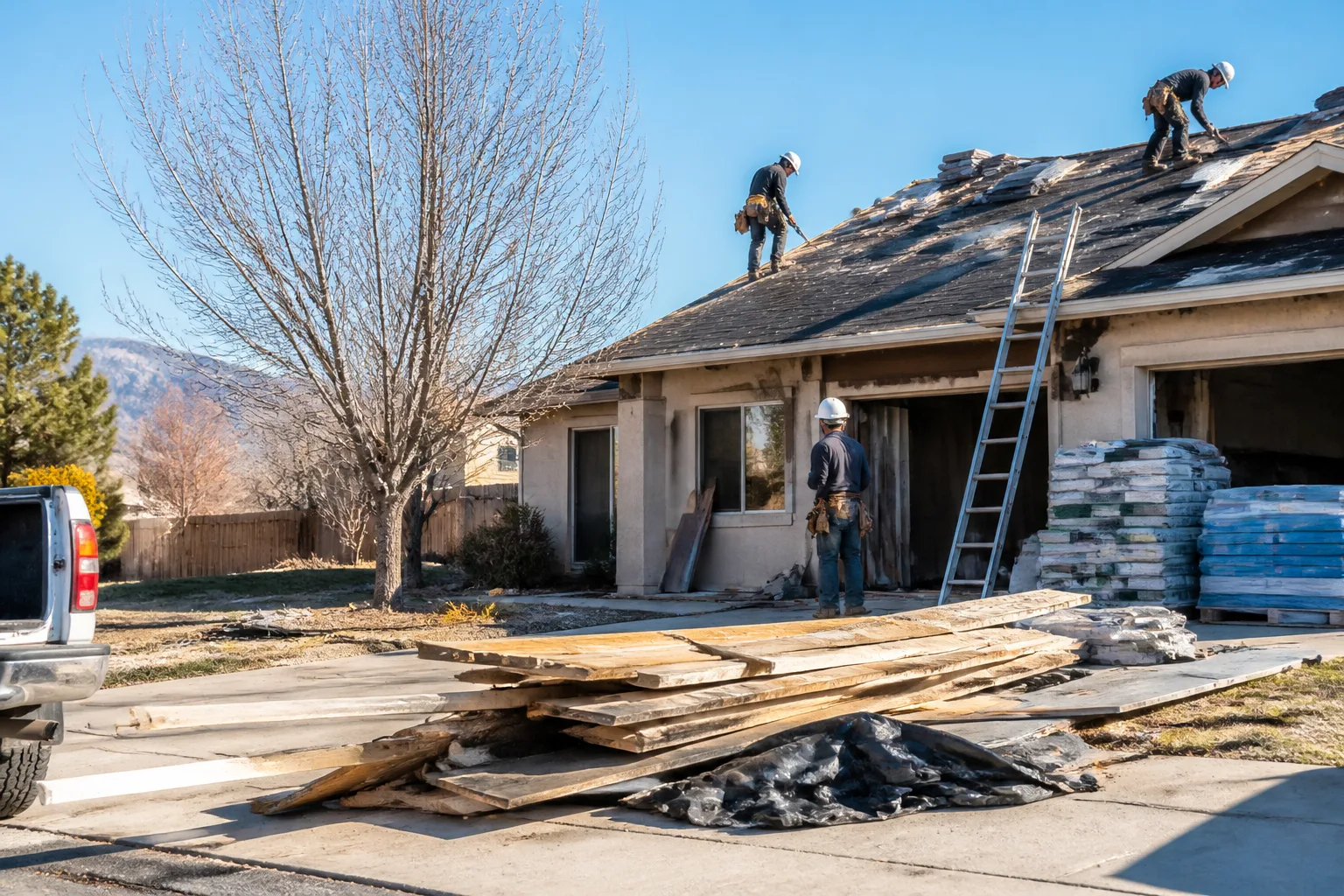
In Victorville, monsoon-season flash rains and winter wind gusts hitting 60-plus mph through the Cajon Pass create distinct damage patterns. We’ve seen water pour through ceiling fixtures in homes off Bear Valley Road within minutes of a downpour, and roofing lifted clean off homes in Spring Valley Lake during a single gust event.
The sequence matters. Before you call a contractor, do this:
- Shut off the source. Water main, gas valve, or electrical breaker to the affected area. If you smell gas, evacuate and call the utility company first.
- Move what you can. Furniture, electronics, documents, anything that can be salvaged from the affected zone. High-desert Victorville homes often have evaporative coolers, and when those overflow, they drench whatever sits beneath them.
- Document everything. Wide shots of the room, close-ups of the damage, a photo of the water meter or breaker panel if applicable. Your phone timestamps these automatically. Use them.
- Call your insurance carrier. Not the contractor. The carrier first. They’ll tell you what documentation they need and whether they require emergency mitigation before restoration begins.
If water is actively migrating through your ceiling or walls, you need the leak stopped. A general contractor who can dispatch quickly and has trade relationships already in place will coordinate a roofer or plumber faster than you can cold-call one from a search engine at 3 a.m. That’s the difference between a company that manages whole-home scope and a single-trade operator who only handles one slice of the problem. One contractor. Every trade.
The CSLB Rules Most Victorville Homeowners Never Hear About
California Contractors State License Board regulations exist to stop predatory contractors from swarming disaster zones and extracting signatures from panicked homeowners. In Victorville, where a storm event can knock out fencing along entire blocks and leave dozens of homes damaged simultaneously, that protection matters.
What you should know:
- Written estimates are required before non-emergency work begins. A contractor cannot simply start tearing out drywall and hand you a bill later.
- You have a right to verify the license. Ask for the CSLB license number, then check it at cslb.ca.gov. It takes 30 seconds. If they hesitate, that’s your answer.
- Emergency work does not waive your other rights. Emergency stabilization – tarping a roof, boarding a window – can proceed faster, but the contractor still must provide documentation for what was done and at what cost.
- Any contractor can be checked for active complaints, citations, or license suspensions. Do this before signing, not after.
The most common mistake we see in Victorville is a homeowner signing a full restoration contract during the first visit. They’re standing in a flooded living room, the contractor seems competent, and the paperwork looks standard. But emergency stabilization and full restoration are two completely different agreements with different scopes, different timelines, and different payment structures. Sign the second one under emotional duress and you could be locked into a relationship that outlasts the damage by months.
Emergency Stabilization vs. Full Restoration: Know the Difference Before You Sign
Here’s the distinction, spelled plainly, because it’s the single most expensive confusion in post-damage recovery.
Emergency stabilization is the short-term work that prevents further damage. Tarping a roof opening. Boarding a broken window. Pumping standing water. Shutting down compromised electrical. This work should happen within hours, and it should be scoped narrowly and priced transparently. You are paying to stop the bleeding, not to rebuild.
Full restoration is the rebuild. New roofing. Drywall replacement. Flooring, paint, insulation, trim. This work deserves the same patience and vetting you’d apply to any substantial remodel, because that’s exactly what it is. Victorian homeowners who rush the restoration phase end up with materials they didn’t choose, finishes they don’t like, and no recourse beyond a licensing complaint that takes months to resolve.
In our experience, the right sequence after damage in Victorville looks like this:
- Emergency stabilization by a licensed contractor with the trades to dispatch quickly.
- Full documentation delivered to your insurance carrier.
- A separate, carefully reviewed restoration contract with clear scope, material allowances, and payment terms.
- Materials specified by name – not “similar to” or “equivalent” – before work begins.
We pulled a tarp off a roof over in the area near Victor Valley College last year where a national restoration chain had charged the homeowner $9,400 for stabilization work that consisted of a tarp, eight hours of labor, and three fans. The insurance carrier paid it. The homeowner was left with the deductible and a repair estimate from the same company that was 40% above local market. That’s what happens when you skip the vetting step.
This is where a full-scope general contractor changes the equation. When we manage storm restoration in Victorville, we handle the roof, the drywall, the electrical, the flooring, and the paint under one contract with one schedule. No gaps between trades. No finger-pointing when something fails. Your project managed start to finish.
What to Document Before Any Work Begins in Victorville
Insurance adjusters in the High Desert see hundreds of claims after every major storm event. The homeowners who get paid quickly are the ones who hand over a complete evidence file on day one. Here’s what that file should contain:
- Time-stamped photos of every affected area from at least three angles per room or surface.
- Photos of the source – the roof penetration, the burst pipe, the window that failed, the fence line that blew over.
- Photo of any visible water line on walls, baseboards, or cabinetry. This tells the adjuster how high the water reached.
- A written log with dates and times: when you noticed the damage, when you shut off utilities, when mitigation began.
- Any written communication with contractors, insurance agents, or utility companies. Text messages count. Screenshot them.
- Receipts for any emergency purchases – tarps, pumps, sandbags from the hardware store off Palmdale Road. These are typically reimbursable.
Victorville’s climate adds another documentation layer. High-desert heat accelerates mold growth in water-damaged areas, especially during summer when interior temperatures can exceed 90 degrees in an uncooled home. Take photos within hours, not days. What looks like minor water staining on day one can bloom into something much worse by day four. The photos establish a timeline that protects your claim.
Why a General Contractor Beats Calling Individual Trades in an Emergency
When a storm takes out part of your roof and your living room ceiling collapses, here’s what the cold-call sequence looks like: you call a roofer. Then a drywall company. Then a flooring contractor. Then an electrician to verify the circuit is safe. Each one schedules separately. Each one arrives without knowing what the previous trade found. Each one hands you a separate invoice and a separate warranty that only covers their slice.
Now here’s what the general contractor sequence looks like: one call. One point of contact. One coordinated scope that routes the roofer first, the electrician second, the drywall crew third, and the painter last, in sequence, without you managing four schedules.
In Victorville, where contractor availability tightens dramatically after major storm events, that coordination advantage compounds. The roofer who works directly with a general contractor’s existing trade network responds faster than one you cold-call from a search result. The drywall crew gets scheduled the day the roof work finishes, not two weeks later. The job moves as a sequence, not a series of disconnected appointments.
That’s the practical difference between a company that carries full whole-home scope and a specialist who only handles one trade. From the kitchen to the roofline, the person managing your restoration should be accountable for the entire job, not one slice of it. When you’re dealing with a disaster, that single point of accountability is the difference between a recovery that takes three weeks and one that drags across three months.
When to Call a Pro
Some damage patterns in Victorville are safe to triage on your own. A small fence section blown over on a calm afternoon, a minor shingle lift, a window screen torn by debris. You can document those, submit to insurance, and gather estimates over a few days without any additional risk.
Other situations demand immediate professional response:
- Any roof penetration exposing the home’s interior to weather, even if the opening looks small.
- Water actively entering the home through any surface, including the foundation. Victorville’s hard-packed desert soil doesn’t drain quickly, and water that pools against a slab will find its way inside.
- Any electrical issue caused by water intrusion. Do not attempt to dry and reuse flooded outlets or fixtures.
- Structural compromise – sagging rooflines, cracked drywall joints that shift when you push, doors that suddenly jam in their frames.
- Gas odor or any suspicion of gas line damage. Vacate, call the utility, and do not re-enter until cleared.
A capable general contractor will tell you honestly whether you need emergency response or can take a measured approach. The right contractor protects your budget by telling you what does NOT need to happen immediately, not by selling you every service they offer. Pro-grade materials, professionally installed, at the pace the situation actually requires.
Victorville’s Specific Damage Patterns Worth Knowing
We’ve worked on enough High Desert homes to recognize the regional signature of storm and environmental damage. Understanding your home’s specific vulnerabilities in Victorville helps you respond correctly when something fails.
Wind through the Cajon Pass and along the Mojave River corridor hits certain neighborhoods harder than others. Homes in the northern Victorville zones, closer to the open desert, take more wind exposure than those sheltered near the foothills. Roof edges, fascia, and fencing bear the brunt. We see more lifted shingle edges and blown fence sections in those areas than anywhere else in the High Desert.
Summer heat creates a different set of failures. Homes built in the 1980s and 1990s across central Victorville often have original roofing systems pushed past their design life by relentless UV exposure. Roofing materials from GAF, CertainTeed, and Owens Corning, properly installed, hold up to that sun far better than the builder-grade products many Victorville homes received at original construction. When a roof fails from age rather than storm, the repair scope expands from patchwork to replacement, and that changes the cost conversation entirely.
Hardscaping and site drainage matter in Victorville too. Flash flooding from monsoon rains doesn’t soak into compacted desert soil. It runs. Homes with poor grading or undersized drainage see water pooling against foundations, garage slabs, and paver areas. Products from manufacturers like Oldcastle and Cambridge Pavers, installed with proper base preparation using materials like Quikrete, hold up to those flash-flood cycles far better than improperly bedded pavers. If your emergency involves water moving across your property, the restoration conversation should include drainage, not just patching the point of entry.
How to Choose the Right Emergency Contractor in Victorville
Take a breath. The damage is done. The water is stopped or the opening is tarped. Now you have a decision to make, and it deserves the same clarity you’d bring to any large purchase. Here’s the evaluation sequence:
- Verify the CSLB license at cslb.ca.gov. Active status, no concerning citations, appropriate classification for the work.
- Ask for a written estimate before any non-emergency work proceeds. If they push back on this, walk away.
- Ask who will actually perform the work. A general contractor who uses established subcontractor relationships will tell you which trades will be on site. A company that hedges on this answer is likely to be outsourcing your job after you sign.
- Ask about material allowances and specifications. You want specific product names – not vague categories. “GAF shingles” means something. “Standard shingles” means nothing.
- Ask about the warranty structure. Which components carry manufacturer warranties, which carry workmanship coverage, and who honors what.
At Stallion Contractors, we carry 50+ established brand partnerships spanning every major home system. That’s not a catalog presence. It means when we specify a roofing material for your Victorville home, we’re specifying products we’ve installed and stand behind, from manufacturers like GAF and CertainTeed. When we restore a paver area, we’re specifying materials from Oldcastle or Cambridge Pavers with proper base preparation, not whatever the supplier has on the yard floor. The material selection is guided by contractor expertise, not showroom upsells.
Related services in Victorville: if your emergency exposed broader remodeling needs, we handle home remodeling and home renovation across the High Desert. For homeowners outside Victorville, we also serve the Colton area as a general contractor. If you’re new to working with us, the Stallion Contractors home page covers our full scope.
The Bottom Line
When a Victorville home is damaged, the first response should be methodical, not emotional. Stop the active damage. Document everything. Verify the license. Separate stabilization from restoration. Make the contractor prove their scope, their materials, and their relationships before you sign a full restoration agreement.
The wrong contractor relationship, locked in during the first 24 hours, creates problems that outlast the damage. The right one turns a crisis into a recoverable sequence of work. Built to the standard your home deserves, and protected by the rights California law gives you.
If you’re in Victorville and need help, Stallion Contractors offers free estimates. Call (855) 600-3192 and we’ll walk the property with you, scope the damage honestly, and give you a written line-item estimate before any work begins.
Frequently Asked Questions
Emergency stabilization – tarping, boarding, water extraction – typically runs $800 to $3,000 depending on scope and access. Full restoration costs vary widely based on the extent of damage, materials specified, and whether the work falls under an insurance claim. Roof replacements in Victorville commonly range from $12,000 to $28,000 depending on size, pitch, and material grade. Call (855) 600-3192 for an exact quote. Estimates are free.
Yes, but the contractor’s role is to document, scope, and restore. The claim itself is between you and your carrier. A good general contractor provides detailed documentation, written estimates that match insurance adjuster line items, and works directly with the adjuster during inspections. We’ve found that carriers respond faster when the contractor submits professional-grade documentation with clear material specifications and consistent pricing.
Emergency stabilization happens within hours. Full restoration timelines depend on damage extent, material availability, and insurance approval cycles. A typical storm restoration in Victorville – roofing, drywall, flooring, paint – runs three to eight weeks from stabilization to final walkthrough. Larger jobs, especially those involving structural repair or full roofing systems, can extend to three months. Call (855) 600-3192 and we’ll give you a realistic timeline for your specific situation.
Do not sign anything. Take their license number, verify it with the CSLB, and get any verbal promises in writing. California law protects you from high-pressure solicitation after disasters, but the protection only works if you invoke it. A legitimate contractor will respect your request to review documentation and get back to you. One who pressures you to sign on the spot is telling you everything you need to know.
Written by the team at Stallion Contractors, serving Victorville since 2011.
Need Construction Help?
Call Stallion Contractors — licensed & insured, here with fast after-hours help in Victorville.
(855) 600-3192